
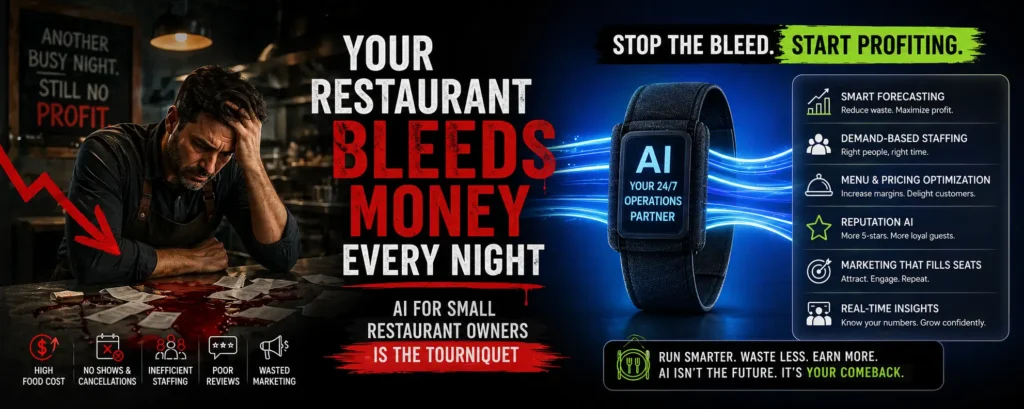
Food waste destroys restaurant economics at a scale most owners refuse to look at directly. The National Restaurant Association pegs food waste losses at roughly $25 billion annually across the U.S. industry. For a single small restaurant doing $800K in annual revenue, that translates to $48,000–$64,000 in raw food cost erosion per year — before you account for labor to prep and dispose of it.
AI for small restaurant owners attacks this at the source. Tools like Winnow and Leanpath connect computer vision to your prep station — they photograph every item you throw away, weigh it, and categorize it automatically. Within three weeks of deployment, they surface patterns your team never tracks manually: you over-order romaine every Tuesday, you prep 40% more hollandaise than you sell on Sunday brunch, your pastry station dumps a third of its daily brioche output.
Real Example
Matteo’s Osteria in Denver (42 seats, $1.1M revenue) cut food costs by 18% in four months after deploying AI-driven waste tracking. The owner eliminated two SKUs from the prep list entirely and renegotiated purchasing frequency with their produce vendor based on AI demand forecasts.
Demand forecasting matters even more. AI for small restaurant owners now includes lightweight POS-integrated tools — Toast Intelligence, Lightspeed Analytics, and third-party layers like Avero — that analyze your historical sales data alongside local event calendars, weather patterns, and even nearby competitor activity. They tell you Monday will run 22% below Tuesday and adjust your par levels accordingly. You stop over-buying. You stop throwing money into your compost bin.
The Staffing Chaos That Eats Your Weekends — AI Solves It
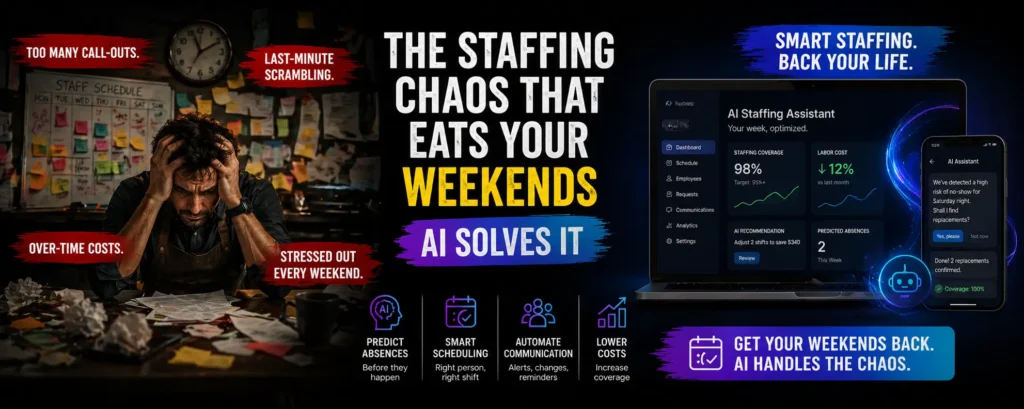
Restaurant owners spend an average of 11 hours per week on scheduling. That number, from research by 7shifts (a scheduling platform with 30,000+ restaurant clients), represents pure operational drag. You shuffle shifts, chase availability confirmations, and rebuild the schedule when someone calls in sick at 4 PM on a Saturday. AI for small restaurant owners eliminates most of that friction.
“AI scheduling tools cut scheduling time by 70% for operators who commit to letting the algorithm run — not overriding it every week.”
AI scheduling platforms — 7shifts, HotSchedules (now Fourth), and Sling — ingest your historical covers data, your server performance metrics, and your staff availability preferences. They generate optimized schedules that minimize overtime, match skill sets to shift demand, and predict likely call-outs based on individual attendance history. When someone does call out, the same system auto-notifies available staff in the correct order and fills the gap without you touching your phone.
The ROI math runs fast. At $30/hour for an owner’s time, 11 hours per week equals $17,160 per year just in scheduling overhead. A platform like 7shifts costs $200–$400 per month. Even at the high end, you recoup the subscription cost in six weeks and bank the rest.
AI for Small Restaurant Owners Turns Mediocre Reviews Into Revenue
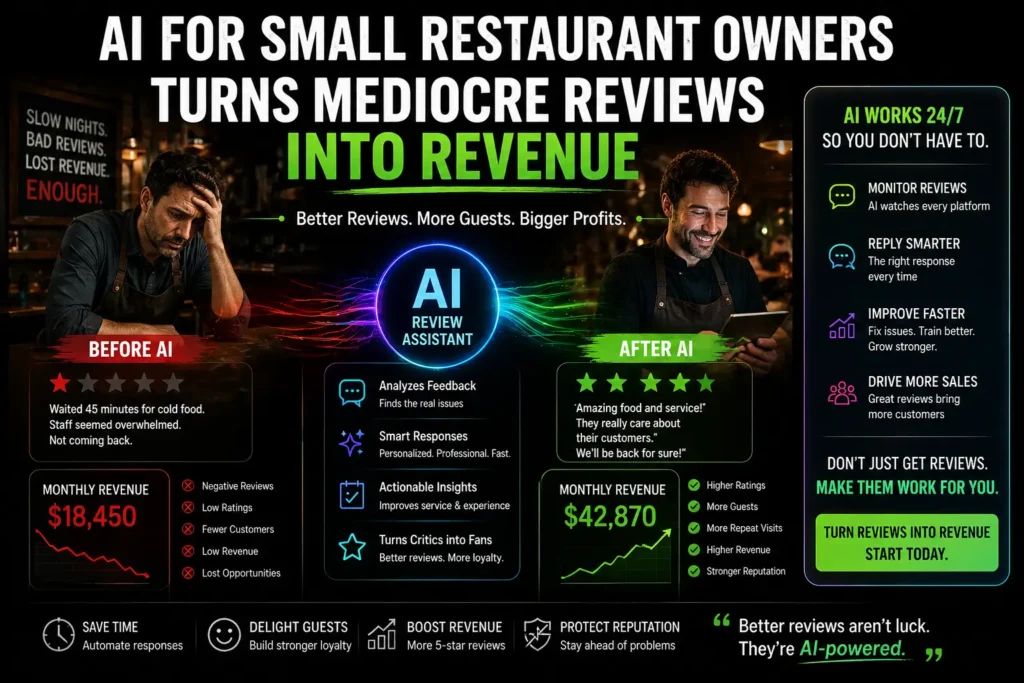
Online reputation operates as a direct revenue lever. A Harvard Business School study found that a one-star increase on Yelp drives a 5–9% revenue increase for independent restaurants. Most small operators manage reviews manually — responding when they remember, missing negative reviews for days, and writing generic replies that signal indifference.
AI for small restaurant owners now handles review response at scale. Tools like Widewail, Reputation.com, and the built-in AI features in Google Business Profile generate personalized, contextually accurate responses to every review — positive, neutral, and negative — within minutes of posting. For negative reviews, the AI flags sentiment severity and routes the most damaging ones to you for personal follow-up while handling the low-stakes complaints autonomously.
Real Example
Juniper Kitchen in Austin (58 seats) went from a 3.8 to a 4.4 Google rating in eight months after deploying AI review management. Response time dropped from 4.6 days to 2.1 hours. The owner attributes a measurable walk-in traffic increase to the improved rating visibility in Google Maps rankings.
Beyond reviews, AI for small restaurant owners includes conversational marketing tools that turn your customer data into targeted campaigns. If you run a POS with loyalty integration — Square, Toast, or Revel — AI layers from platforms like Popmenu and Olo analyze guest behavior and trigger hyper-personalized re-engagement campaigns. A guest who ordered the lamb shank twice and hasn’t returned in 45 days gets a specific promotion. Not a generic discount blast. The conversion rate difference between these two approaches runs 4–7x, according to Popmenu’s published data.
The Real Barrier Isn’t Money — It’s the First Deployment
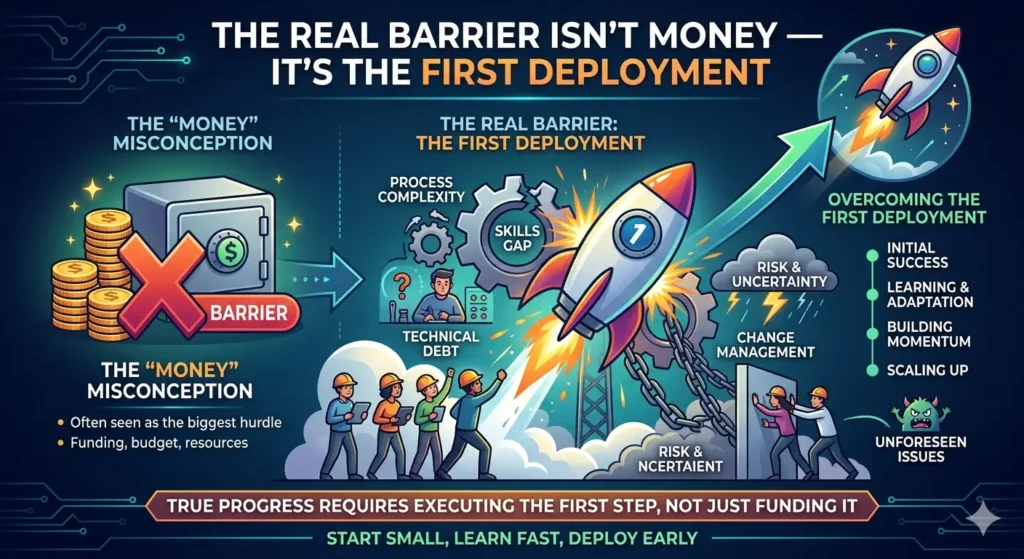
The honest obstacle to AI adoption for small restaurant owners isn’t budget. A functional AI stack — waste tracking, scheduling, review management, and basic demand forecasting — runs $400–$900 per month across platforms. For a restaurant doing $700K+ in revenue, that’s under 0.1% of top line. Every tool in that stack pays back within 90 days through waste reduction and labor optimization alone.
The real barrier is implementation friction. Restaurant owners run at 110% capacity. Finding time to onboard a new system, train staff, and trust the AI recommendations rather than gut instincts requires deliberate commitment, not just a credit card. The operators who win with AI for small restaurant owners treat the first 30 days as an investment — they accept suboptimal scheduling outputs while the algorithm learns their business, they let the waste tracking system capture data before acting on it, and they brief their front-of-house team on why the system exists.
The operators who fail do the opposite: they override the AI on week two because the schedule “doesn’t feel right,” they ignore the waste data because it contradicts their intuition, and they abandon the tool before the signal emerges from the noise. AI for small restaurant owners requires a three-month commitment minimum to surface actionable ROI. Every operator who has made that commitment reports they cannot imagine running operations without it.
Start with one tool. Pick your biggest pain — waste, scheduling, or reputation — and deploy one system. Run it without overrides for 60 days. Then expand. The compound effect of AI across multiple operational areas is where the economics become genuinely transformative for small restaurant owners.
The restaurant industry’s brutality — thin margins, punishing turnover, perishable inventory — makes it exactly the environment where AI for small restaurant owners delivers the highest return per dollar deployed. Your competition already runs leaner with these tools; the question isn’t whether to adopt AI, it’s whether you can afford to watch another year of margin erosion while you decide.
written by clickoura.com